Tuesday, 2 March 2010

On the other side - Letters to my children (Mathilde Woolf-Monckeberg)


Letters to my children is a Persephone title that I might not have picked up had I not decided earlier in the year to try and obtain (and read!) the complete set of Persephone books. Written by Mathilde Woolf-Monckeberg in Germany during the Second World War, these letters were the letters that she was not able to write to her children:

"My beloved far-away children, everything I was not able to tell you in my letters during the first year of the war, was not allowed to say, because the censor waited only for an incautious word in order to stop a message from getting through to you, all this I will now put down on paper under the title "Letters that never reached them" so that much later perhaps you will know what really happened, what we really felt like, and why I had to reassure you repeatedly that the "organisation" was marvellour, that we were in the best of health and full of confidence"

The author was 60 when these letters were started; she had five grown up children, having married young. Having separated from her first husband, she had remarried by this point to a Professor of English at Hamburg University. The children lived across the globe, in Wales, Chicago, South America...

Life in wartime Germany was harsh. In the first letter we read about the shortages, but also about the conditions being imposed on Jewish friends, which had led to many committing suicide. It was almost impossible for Tilli to communicate with her children; she relied on news being sent via the family in Chicago, but even then she had to wait a long time for news of her latest grandchild. Similarly, when her son Jan died of a ruptured bowel after surgery in South America she did not hear for a while. It's difficult to imagine not being able to be in touch with those who one loves.

The letters continue into 1945, describing what life was like after Germany lost the war. Like Britain, the hardships continued well into the 1950s, and were not mitigated by the sense of victory. Tilli's husband however was appointed to the position of Rector at Hamburg University, and at least the threat of bombing had disappeared.

Domestic life is a common thread amongs many of the Persephone series and this book is no exception. We read about Tilli queuing for frozen vegetables and her joy at coming away with three packets of apple sauce.

Persephone mention on their website that this book was partly published to provide a counterfoil to Vere Hodgson's Few eggs and no oranges; it is certainly easy to forget that the German people suffered just as bad deprivations as those in England, and suffered just as much, if not more in some ways. Allied bombing was just as traumatising, and people in Germany lost relatives and friends as a result too. Letters like this did not get out of Germany because the country had to promote an image of a nation that was able to defeat the British in order to destroy British morale.

This Persephone edition is particularly interesting because it contains an afterword written by Tilli's daughter Ruth, who discovered the letters languishing in a drawer in the 1970s and translated them for publication. There is also an afterword by Christopher Beauman which contextualises the letters historically and a preface which provides the background to Tilli's circumstances.

I thoroughly recommend this fascinating and engrossing account to provide a counterpart to reading about the Second World War in England and for supplying an insight into what domestic life in Germany was like at this time.

Monday, 1 March 2010

February Reading

I read 102 books in February. Somewhat excessive, but it reflects the fact that:
1. my fiance is doing most of the household chores as he's not currently working
2. I now have a job with proper tea-breaks
3. Continuing ill-health is limiting my social life to the sofa
4. It's too cold to go out and do anything in the evenign anyway
5. After a day spent staring at the computer screen I'd rather read than watch tv or blog (which is why I've only written about a handful of these titles).

As you can see this month I've re-read a lot of Lorna Hill books and Chalet School books. The former fitted in with my trip to the ballet and acquiring them; the latter are just perfect comfort reading. I've also continued to read plenty of Virago Modern Classics. I also got seriously stuck into some Cornish reading, and particularly enjoyed discovering Janie Bolitho Highlights were Jacqueline Wilson's My secret diary (post to come), Mathilde Wolff-Monckeberg's Letters from the other side (ditto), Oliver Postgate's memoir, and the two Helen Humphreys books that I read. The VMC highlights were more Elizabeth Von Arnim, particularly The caravaners and Vera , Sheep's Clothing (Celia Dale), Mary Lavelle (Kate O'Brien) (reviews for these are all queued up and will be appearing over the next month), and The Valley of the Dolls.

My plans for March include reading the rest of the Lorna Hill books I acquired lately, as I have two more ballet trips lined up, and carrying on with my Virago Modern Classics. It would be lovely to get some books off my TBR pile too as lots of the books have been sitting there for a while - I've got a couple of Honno classics that I just haven't yet had time to read and still a couple of Persephones that I'd love to indulge in. From my library pile I want to read Good companions by Priestley and the new novel by Clare Morall. A large part of my TBR shelf has been moved into a suitcase pile (this is a clever reorganisation to make it look smaller), but I need to work out exactly which books I want to take when I go on holiday at the beginning of April...

Here is the list in its entirety....

The passion of new eve

Carter, Angela


Suth of the night

Toibin, Colm


A sensible life

Wesley, Mary


New mistress at the Chalet School

EBD

C RR

Fortune house

Scott, Kirsty


Mr Skeffington

Arnim, Elizabeth von

VMC

The Casino

Bonham, Margaret

P

Magic of a line

Knight, Laura

AB

Careless in red

George, Elizabeth


Excitements for the CS

EBD


Land girls gang up

Peters, Pat

AB

Couples

Figes, Kate

NF

The barren ground

Glasgow, Ellen

VMC

Plotted in Cornwall

Bolitho, Janie


Coming of age of the CS

EBD

C RR

Two days in Aragon

Keane, Molly

VMC

Village by the ford

Channer, Gordon

AB

A year at Polverras

Duston, Sylvia


Part of the scenery

Wesley, Mary

AB

Tell it to a stranger

Berridge, Elizabeth

P

Richenda at the CS

EBD

C RR

Spinster

Warner, Sylvia Ashton

VMC

Pattern on the jigsaw

Drabble, Margaret

AB

Pirates at play

Trefusis, Violet

VMC

Seven sisters

Drabble, Margaret


Recipe for scandal

Holt, Debby


Rough guide to the Lake District


NF

The caravaners

Arnim, Elizabeth von

VMC

Saving grace

Bolitho, Janie


No castanets at the wells

Hill, Lorna

C RR

Anna Apparent

Bawden, Nina

VMC

A gull on the roof

Tangye, Derek


Sheep's clothing

Dale, Celia

VMC

Paying the price

Bolitho, Janie


Jane at the Wells

Hill, Lorna

C RR

Mary Lavelle

O'Brien, Kate

VMC

Main cages

Marsden, Philip


After image

Humphreys, Helen


Age of innocence

Wharton, Edith

VMC

Masquerade at the Wells

Hill, Lorna

C RR

School house in the wind (trilogy)

Treneer, Anne

AB

Check out girl

Ahmad, Tazeen

NF

The fire-dwellers

Laurence, Margaret

VMC

Quickening ground

Gabriel, Hayden


Coventry

Humphreys, Helen


Wheel on the Hayle

Channer, Gordon

NF

Love

Arnim, Elizabeth von

VMC

Whole wide world

Woof, Emily


Anything for love

Webb, Sarah


Dancer's luck

Hill, Lorna

C

Richer the poorer

West, Dorothy

VMC

Proper education for girls

Di Rollo, Elaine


Duchess of Bloomsbury

Hanff, Helene

AB

Cornwall and Devon holiday diaries

Haywood, Beryl

AB

Belle's best move

Moss, Alex

C

Miss Herbert

Stead, Christina

VMC

It's a don's life

Beard, Mary

AB

Joey and Co in Tirol

EBD

C RR

Betrayed in Cornwall

Bolitho, Janie


Summer in February

Smith, Jonathon


Women against men

Jameson, Storm

VMC

Wild Mary

Wesley, Mary

B

Losing Battles

Welty, Eudora

VMC

Nine wartime lives

Hinton, James

NF

Manna from Hades

Dunn, Carola


Change at the CS

EBD

C RR

Painted clay

Boake, Capel

VMC

Seeing things

Postgate, Oliver

AB

A proper place

Lingard, Joan

C RR

Megan (3)

Hooper, Mary

C

Moonshine

Jones, Christina


A Saturday life

Hall, Radclyffe

VMC

Both ways is the only way I want

Meloy, Maille


In my own time

Bawden, Nina

AB

The Montana Stories

Mansfield, Katherine

P

A load of old tripe

Phinn, Gervase


Valley of the dolls

Susanne, Jacqueline

VMC

Second fiddle

Wesley, Mary


Two sams at the CS

EBD

C RR

They tied a label on my coat

Hollingsworth, Hilda

AB

Dancer in the wings

Hill, Lorna

C RR

Twenties girl

Kinsella, Sophie


Miss Mole

Young, E.H.

VMC

Helping hand

Dale, Celia


Life of Reilly

Burke, Paul


The diviners

Laurence, Margaret

VMC

Full circle

Bolitho, Janie


The three Miss Kings

Cambridge, Ada

VMC

The wooden doctor

Evans, Margiad


Letters to my children

Wolff-Monkeberg, Mathilde

P

Seven secrets of happiness

Owens, Sharon


Summer at Gaglow

Freud, Esther


Cindie

Devanny, Jean

VMC

The peppered moth

Drabble, Margaret


The Garrick year

Drabble, Margaret


My secret diary

Wilson, Jacquline

C AB

Vera

Arnim, Elizabeth von

VMC

The long song

Levy, Andrea


The winged horse

Frankau, Pamela

VMC

Dubious legacy

Wesley, Mary


Memoirs of a not so dutiful daughter

Murray, Jenni


When to walk

Gowers, Rebecca


Friday, 26 February 2010

Cornish Cornucopia #4 Some fiction


The first proper novel I read as part of my Cornish inspired reading was The main cages by Philip Marsden. I had not heard of Philip Marsden before, but according to the blurb on the fly leaf he is an eminent writer, predominantly focussing on travel writing, Fellow of the Royal Society of Literature and winner of the Somerset Maugham Award. This is his first novel.

Set in the 1930s a small Cornish village near Penzance called Polymayne, the Main cages is a book framed by a group of perilous rocks outside Polmayne. It starts with a tragic shipwreck on these rocks and their presence hangs over the entire tale. In between Marsden paints a picture of the community and its characters; the fishermen, the hoteliers, the painters, the visitors on holiday. We follow the main character Jack Sweeney, a newcomer to the town as he falls in love with an artist named Anna. But given the opening of the book and the oppresive presence of the rocks, the whole tale is overhung with a sense of foreboding.

"Even in this deadest of dawn seas, the Main Cages picked out a swell where there appeared to be none. It came in from the east, each wave mounting as it approached the first of the rocks, the Curate. The crest steepend and began to curl, and just before it broke, the water was sucked away from around the rock and it was exposed, a brief black island hung with strands of draining white"

I loved his particular style of writing which felt almost like a medieval chronicle in places. Individuals were sparsely introduced and events related in a bare fashion before being fleshed out with more detail. It was also interesting to read a tale of the 1930s; often books set in this time have the threat of war hanging over them, but this didn't, and this may actually reflect the experiences of the ordinary people of the time.

I'm not sure whether I would seek out more works by Marsden because I liked this best for being a book about Cornwall but it was certainly a good way to kick things off.

*********


Another suggestion from Fleur Fisher, The quickening ground was an immensley enjoyable Cornish read, telling the story of two women, 100 years apart who inhabit the same farmhouse near Newlyn. Claira in 1886 has just moved in after getting married to her husband, and Claire in 1986 has moved in after her family decide to leave their city existence for a less stressful life near the sea. The pair's lives intertwine after Claire discovers a nineteenth century painting from the local Newlyn school. It's a cleverly written story that kept me guessing up until the end.

But the reason I read this book was for its connection with Cornwall, and I wasn't disappointed in that either. The story itself might not be a new concept, but the descriptions of Cornwall are beautiful.

***
Summer in February seemed like an appropriate read for this time of year, but turned out to be even more timely than I had anticipated given my reading of Laura Knight's autobiography earlier on in my Reading Cornwall adventure. This is a beautifully told and meticulously researched book about the community of painters in Newlyn and Lamorna before the First World War. Characters such as Laura Knight and Alfred Munnings feature. Ultimately, it is a love story following what happens when two of the men fall in love with the same woman, but it is so very much more than that, detailing the lives of the characters, and describing the wonderful landscapes. I read on the internet that there are plans to make this into a film and think that this would be fantastic!


Wednesday, 24 February 2010

Three review copies


I recieved three review copies in the mail last week, and having excitedly read my way through them, I thought I would mention them on my blog while they were still fresh in my mind.

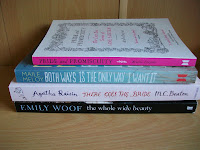
The whole wide beauty (Emily Woof)
I recieved this book through the librarything.com early reviewers programme which sends out proof copies to members to review on the website. What a privilege it was to have the opportunity to read this book ahead of publication. Although a debut novel, The whole wide beauty by Woof is an incredibly accomplished novel dealing with the big issues of life - the need to love and be loved, the problem of conflicting roles and interests and the need to find fulfilment. It's the story of a woman named Katherine Freeman, an ex-ballet dancer who now lives with her overworked husband, young son and works part-time as a music teacher. Her life suddenly changes when she meets a poet at an arts event organised by her father, and they embark on an affair, trying to fill the gaps of love and intellectual fulfilment in their lives. Emily Woof is better known as an actor with an long list of film and theatre credits to her name; however this is an impressive novel and I hope that she will be writing another.

Pride and promiscuity
There seems to be a huge number of Jane Austen spin offs of late, and this book, sent to me by Canongate, is among them. To be honest, I wasn't grabbed by it. The basic premise of the book is that a Jane Austen scholar finds some lost Austen manuscripts containing sex scenes, which got left out of her finished publications and shed a whole new light on the author. It is obviously a parody, but I found the sex scenes badly written (see this interesting blog post by Jackie about sex in literature), and for me it didn't add anything to a Jane Austen experience.

Both ways is the way I want it (Meloy)
Having loved both of Meloy's novels, Liars and Saints, and a Family Daughter, I was excited when Canongate sent me her latest. Unfortunately it turned out not to be a novel, rather a collection of short stories, but having got into some short stories recently I was rather more open minded than I might otherwise have been. And I'm glad I did and I found it to be a great collection which makes me hope even more that Meloy writes another novel!

The first story was probably my favourite. It concerns Chet, who by accident ends up attending an adult education course in law. The tutor signed up to teach the class before getting a full-time job nine and a half hours drive away, but didn't want to let people down, so has driven miles to get there. Chet really wants to get to know her, and they bond in the cafe after the class. Even though he isn't signed up to the class, he returns the next session to see her and they go to the cafe again, even though she is exhausted. This happens one more time, and then he kisses her. The next class, she doesn't turn up; a man is in her place, she has found the travelling too exhausting. Chet drives 9.5 hours to try to find her, despite not knowing where she lives. He is scared that his kiss has scared her off. They meet, but she tells him she had already asked for a replacement but that she had not got around the mentioning it. Chet has little option but to drive home again; stories do not always have the happy ending.

I also recieved a copy of the latest Agatha Raisin book, There goes the bride, which I won on Simon S's blog. I've not read any of the Agatha Raisin books so it's nice to have the opportunity, though I'll be lending it to my Mum first as she's much more into crime than me!

Tuesday, 23 February 2010

Library loot


Going to the library is such an addiction, but it's free and never fails to cheer me up (like daffodils do!). A colleague confessed to me the other day that he finds himself visiting the Central Library several times a week, and then often pops into his branch library on the weekend. I admitted that I am the same. These books are loot from last week - a couple of trips to the Central Library and one trip to the branch library.

A load of old tripe is a light novel by Gervase Phinn, more famous for his books about school inspecting in Yorkshire.
Summer at Gaglow is by Esther Freud, an author who I have enjoyed previously, and starts during WW1.
Caught in Cornwall by Janie Bolitho will form part of my Reading Cornwall, and is the last Rose Trevelyan detective story set in the county - I've already enjoyed a couple of the others in the series.
My secret diary by Jacqueline Wilson is the author's autobiography written in a similar style to her children's books. I was a bit too old for Jacqueline Wilson as she came to prominence when I hit my teens, but she was always a guilty pleasure when I needed something unchallenging.
In my own time is Nina Bawden's autobiography - I've enjoyed a lot of her adult books as part of my Virago Venture, so it will be interesting to learn more about the person behind these books as I suspect that they have many autobiographical moments.
The long song by Andrea Levy came from the new books shelf and I feel lucky to have got this so soon. Although not a fan of Small Island, I've loved her other novels and will be interested to see what I make of this.

Do any of these appeal to you?

Monday, 22 February 2010

Seeing things (Oliver Postgate)


I watched a hugely fascinating documentary on BBC4 the other night (which was in fact a repeat of a Christmas programme that I had missed) about the filmmaker Oliver Postgate, responsible for bringing us Bagpuss, The Clangers, Ivor the engine, and essentially setting out the ground for the children's television that is shown today like the Teletubbies, The Fimbles and In the night garden. I remembered seeing his memoir, and I was lucky enough to be able to obtain a copy from Canongate, who published it.

Postgate's memoir begins with a wonderful description of his upbringing in the interwar years, followed by a spell at art school, but it was during the Second World War that the book really started to get interesting for me. I wrote a little while ago about how I had written a dissertation on conscientious objectors during the First World War, and in fact one of the individuals that I focussed my research upon was his father Raymond. Oliver Postgate made a conscientious objecting during the Second World War. Although Raymond did not object to the Second World War in the way that he had to the First World War, he was still reasonably supportive of Oliver's objection, in a way that his own father had not been. I was fascinated by Postgate's description of trying to register his objection; he failed to report for duty, but nonetheless turned up to the barracks to report himself failing to report for duty. The authorities didn't know quite what to do with him! In the event after a spell in prison, he worked on the land for the remainder of the war.

After the war, Postgate followed a number of pursuits; he attempted to develop a career in theatre. But he also tried his hand in particular at invention. He made his mother a "washing machine" which terrified her, as the motor moved the box around the shed in which it was kept and she was scared that it was going to come to get her! He also made some props for theatre and television, such as an amazing collapsable souffle, which could be deflated by the actress using her thumb when she took it out of the oven. It is easy to see the person who was later to create the wonderfully inventive animations.

Postgate's television work and animations in collaboration with Peter Firmin was only dealt with towards the end of the book. Finding himself disappointed with current output, he came up with a number of ideas, but it was not until Noggin the Nog that they achieved success. Bagpuss, The Pogles, Ivor the engine, and of course The clangers all followed in due course. I loved reading about their creation from the creator himself! Being a huge Clangers fan I was especially interested in that section; I knew about the legendary episode which the BBC very nearly didn't show because they objected to Major Clanger swearing (for those of you who never saw them, the Clangers communicated by making whistling noises, but in order to make it authentic, scripts were written and then "whistled" on 6 special Clangers whistles by Postgate and Firmin), and I knew that it was possible to hear sense in the whistling noises, but I didn't know that, although the scripts were English, German and French viewers found the noises equally intelligible and believed the Clangers to be speaking their languages!

This book was actually originally written in 2000, but this new edition by Canongate was issued in 2009 after his death in 2008 and features a postscript by one of his sons. The book has wonderful illustrations at the start of each chapter by Peter Firmin, Postgate's collaborator on many series, and this hardback edition has a lovely embossed cover. I do really recommend this book as a hugely interesting autobiography and an absolute must-read for anyone who enjoyed/enjoys The Clangers, Bagpuss, or any of the other children's programmes.

(And as a post-script, here is my very own Clanger, which one of my college friends knitted for me several years ago after I spent a year wearing Clangers t-shirts and with a Clangers decorated bedroom!)

Friday, 19 February 2010

Cornish cornucopia #3 Crime

Although I usually tend to avoid crime books, I have made a bit of an exception over the last couple of weeks as there are a number set in Cornwall, and I have to admit to being pleasantly surprised at how much I've enjoyed this venture into pastures anew. I have not discovered great literature, but I have encountered gripping page-turners.


I'm not a complete stranger to Cornish crime; I was a devotee of the television series Wycliffe, broadcast in the 1990s, and often repeated on ITV2, for the scenery and wonderful opening music. I subsequently read a lot of the books which they were based on, although if I'm honest I never really enjoyed the books as much as the series.

However, a number of crime books and series were recommended to me when I embarked on this challenge, so I decided to dive in and sample some.

The first book I tried was Careless in red by Elizabeth George, recommended to me by EllenB. This got my attention because rarely for Cornish fiction it is set on the North coast as opposed to on the South coast, and this is the area with which I am most familiar and can picture most vividly (I think this is important in reading fiction by place...). Although reviews on Amazon are somewhat damning, suggesting that it does not live up to George's usual standard of crime novel, I did not have any preconceptions about it. The book opens with Inspector Lynley undertaking a walk along the coast path as part of the process of grieving for his wife; he has gone incognito, literally only in the clothes he is wearing, trying to find some peace. On his 43rd day of walking, he sees a climber fall to his death, and suddenly becomes embroiled in a murder enquiry. Although this story is the main driving force behind the book, there is a complicated cast of characters, the inhabitants of the nearby village, and George deals with family relationships making a much more complex story than I anticipated. I'm not sure that I would seek out more Inspector Lynley novels to read, but I did enjoy this one with its Cornish setting.

Various people suggested Janie Bolitho's Rose Treveylan mysteries. These are a series of detective novels set in Penzance. It would have been good to start at the beginning of the series, but the library only had Plotted in Cornwall on the shelves so I started 6 books in. I will definitely be requesting the others as I really loved it. It wasn't so much of a page-turning mystery as the Elizabeth George, but I liked it more for being a novel about a woman who is a painter and photographer and for being a book about the characters as much as the events. There was also a slightly smaller cast than in Careless in red which made it easier to follow. In some ways I found it reminiscent of the Veronica Stallwood books, set in Oxford, which are the only other crime novels that I have enjoyed previously. So, if you fancy a fairly easy read set in Cornwall with some elements of mystery and detection, then do seek this out.

Wednesday, 17 February 2010

Lent

A spectacular FAIL has occurred with the Frugal February and book-buying ban that I announced over a fortnight ago. I'll bore you with my excuses - the dismalness of the February weather, the continuation of my exclusion diet, and some ill health creating a general need for cheering up which was most easily assuaged by ebay, and the excitement of the Cornish cornucopia and discovering the general unavailability of Cornish books in Oxfordshire made it impossible to resist Amazon's market place. On the plus side, I have managed to avoid bookshops, and where I haven't, I've at least managed to avoid buying anything.

However, as you can see from this picture the TBR shelves are threatening to become a whole bookcase of shame again, so I'm hoping that I can actually try to resist purchasing books to cheer myself up, and at the same time make inroads into these piles.

Lent starts today, so it's time to make a new start and see if I can keep going until Easter Saturday, which also happens to be the lesser known feast day of April 3rd this year (aka my birthday).