Thursday, 27 May 2010

A foray into the domestic arts (part 1)

Back in January I decided to take up knitting. This was something I did as a child - knitting long, holey scarves for my cuddly toys - but had not done in at least a decade an a half. My decision was prompted by spotting the pattern for a very pretty little flower corsage in a magazine - I wanted one myself, and thought that they would make excellent birthday gifts for my friends. Unfortunately, I had almost completely forgotten how to knit. A knitting book from the library later, a trip to a knitting shop for needles and wool, and I realised that perhaps a flower corsage was a tad ambitious. So, I decided to start by knitting a dishcloth; I have a very eco-friendly friend who I thought would love a dishcloth for her birthday, so I chose an attractive shade of pink and congratulated myself on the fact that I had five months to finish it. It was slow progress - I found knitting very very tiring at first, and combined with my tiredness at starting a new job and ongoing health problems, it was soon abandoned. A fortnight ago, I realised that my friend's birthday was in just a week's time, and guiltily took up my needles. Unfortunately, despite knitting hard, I didn't manage to finish it in time (she got some rather yummy books instead, lucky girl), but a week late, I did eventually cast it off. And here it is - some dropped stitches, a bit wonky, but actually something I'm quite proud of. And at least it's not too nice to use :)


My next project is to learn how to do purl; a colleague tells me that dishcloths or scarves are definitely the best way to practice, so maybe my friend will get another cloth in time for Christmas. My colleague has promised to show me how to do that, and also to translate the original corsage pattern for me. I am confident that I will get there eventually!

Wednesday, 26 May 2010

Orange Wednesday: The Bonesetter's daughter (Tan)


When I spotted Amy Tan's The joy luck club in the library booksale for 20p, I couldn't resist it. This amazing multistranded debut novel tells the story of four Chinese mothers and four first generation Chinese-American daughters. The novel is cleverly constructed so that it is almost like a collection of stories - the mothers reveal their experiences of growing up in China, and these are contrasted with their daughters experiences in America. I found it to be a wonderful evocation of mother-daughter relationships as well as a fantastic insight into both Chinese and immigrant cultures.

Whilst this was not longlisted for the Orange prize, two of her later novels had been: The bonesetter's daughter and The hundred secret senses. And having read The joy luck club, it was not long before I sought one of them out.

If anything, I enjoyed The bonesetter's daughter even more than The joy luck club. It was somewhat similar, in that it combined the experiences of a first generation Chinese-American daughter with that of her mother in , but I felt that by focussing on just one pair, the characters and the story were much more developed. Ruth and her mother LuLing have many of the same issues as the women in The joy luck club - Ruth frequently struggles to understand her mother who, despite having lived in the United States for 50 years, is very keen to hold onto her Chinese customs and heritage and only speaks very poor English, and her mother has obviously had to try to come to terms with bringing up her daughter in a culture very different from the one that she was brought up in. This becomes more apparent after the mid-section of the book which describes LuLing's story of life in a small village in China in the 1930s.

Amy Tan's writing is both beautiful and easy to read, so coupled with an interesting story and details about a culture with which I am not particularly familiar, I hugely enjoyed this novel.

I'm extremely keen to get hold of The hundred secret senses now, but I'm also intrigued to seek out her memoir, The opposite of fate. Has anyone read either of those?

Tuesday, 25 May 2010

Some new baking toys

I'm increasingly recognising the importance of good presentation to my baking; partly this is a result of reading wonderful cake decorating books, partly having watched Raymond Blanc's cookery series, and partly just trying a bit harder. It's not something I'm very good at, so I often rely on other things to help me! I couldn't resist a set of gorgeous mini silicon loaf tins the other day; I have never tried cooking with silicon before and these were such pretty colours.

I made two different recipes to try them out - firstly, a basic sponge recipe, which I flavoured with orange zest and sultanas and then covered with a thick orange icing...

Secondly, some dairy free flapjacks into which I mashed banana and stirred in some jam. Yum! I've now got oats back in my diet and am making up for lost time with flapjack consumption.
I didn't notice any difference to cooking with regular baking tins, aside from the fact that I didn't need to line them. My only quibble was the size - they were a bit on the big side for an individual portion. But they are rather pretty.

And, going back to presentation - I made some more apple flapjack the other week, and decided to press them into mini tart tins to make them look a little different...

Monday, 24 May 2010

Bloggiversary (and name change!)


Yesterday marks exactly a year since I started my blog. And what fun I've had along the way! I've made scores of new friends across the globe, fuelled my book addiction more than I would ever have thought possible both in terms of numbers of books borrowed from the library, and books bought (although I have undertaken two successful periods of abstention from the latter). I've embarked on reading projects, such as my Cornish Cornucopia, and my Orange Wednesdays. I've had the privilege of hosting two wonderful Persephone Reading Weeks, and tea as a result at the Persephone Book Shop, and been given my very own Persephone endpaper pinny (see above!). I've won several people's giveaways, been sent books by people reading my blog (and other things too like handknitted scarves!), and been the fortunate recipient of a number of review copies, particularly from the kindness of Sophie and Victoria at Virago, Fiona at Vintage and Helena at Honno Press. I've baked copiously. And it turned out that one blog wasn't enough - I started a second blog too for my challenge of trying to read my way through the Virago Modern Classics series!

It's been wonderful - thank you to all of those that read and comment on my blog - you're all fantastic!

When I set up the blog, I chose "cardigangirlverity" for the web address, but then decided to call it The B Files to reflect the fact that I loved Books, Baking and my Boyfriend. I still love Books and Baking but the Boyfriend is now a fiance, and I feel that my cardigans are becoming neglected*, so from now on my blog will just go under the header - cardigangirlverity.


* Early on I wrote a post about my cardigans - I've got rid of two on the list (the bobbly grey Jane Norman one and the then unworn H and M charcoal cardigan which shrunk terribly in the wash), but have acquired another black Jane Norman cardigan with a lovely big cowl neck and a sparkly silver zipped number from Pineapple which is very eighties funky.

Sunday, 23 May 2010

Sunday cake (and some hearts)


My OH has been away for most of the week - he's back this afternoon and here's what I've made to welcome him home - it's a cranberry, ginger and pecan loaf (from here) which I decorated with marzipan. Ostensibly a Christmas cake, it did lend itself rather well to being decorated like this.

BTW, I've been meaning to post a picture of my heart themed kitchen equipment for quite a while - here it is...we have ice cubes, many many cookie cutters, measuring spoons, a little silicon tin, two Le Creuset ramekins, silicon muffin cases, ice cubes, sprinkles, a set of four spoons and the mug which my OH gave me for my birthday!

Friday, 21 May 2010

Trespass (Tremain)


I first encountered Rose Tremain the summer before last when she won the Orange Prize with The road home - regular readers of this blog will know that I use the prize to extend my reading into authors that I haven't previously come across, and for me, I found The road home to be a worthy winner. I discovered that Tremain had quite a substantial backlist; her historical titles were strongly recommended to me (particularly The colour and Music and Silence, neither of which I have yet got around to reading), and I read a couple of her more modern novels (The swimming pool season and The way I found her). Tremain is one of those writers who seems to write extremely widely, something I always find particularly impressive (as it is often rather tedious when a favourite author becomes boring by churning out extremely samey reading material)

Trespass, Tremain's latest novel, kindly sent to me by Fiona from Vintage to review, is one of Tremain's "modern" novels, and is located in France, in a setting not dissimilar to that of The swimming pool season. This is a book about siblings; brother and sister Veronica and Anthony, both English, and brother and sister Aromon and Audrun, who are French, and the theme of the book is sibling rivalry, dispute and ultimately revenge.

Aramon and Audrun have had a feud for years, but it is not until Anthony, who, escaping his life in England to live near his sister, comes to buy Aramon's house that things come to a head. It is obvious from the beginning that something bad is going to happen to the characters in this book; the question is how and it is difficult to synopsis the plot any more without giving too much away.

All of the four main characters are profoundly damaged human beings, and the book gets its name from the fact that all of the characters have been responsible for a "trespass" in some way, albeit not necessarily in the conventional sense involving land; I found this concept to be more interesting than the plot itself, and the idea that trespassing can be metaphorical as well as literal.

Unfortunately I felt that in comparison to The road home, the book was quite slow. The langorous descriptions of the French countryside may have been appropriate, but they didn't help to keep my interest in the book. So I'm afraid that this wasn't my favourite Rose Tremain to date. Has anyone else read this yet and what did you think? And do you have a favourite Tremain novel - as I have read very few I'd be interested to hear what people recommend.

Thursday, 20 May 2010

Shiny pennies and grubby pinafores (Foley)


I have always had a fascination with autobiographical writing; it fills in the background to the past and adds colour and interest that I didn't initially get when I studied history. Of course, the further into my history degree I got, the more I realised that autobiographies and memoirs were a hugely important part of studying the past, providing a basis for studying social history, revealing details about everyday life and experiences. Even though I no longer study history in any formal sense, I still frequently seek out stories of the past, particularly when they focus on the domestic sphere.

A long time ago, I read Winifred Foley's classic autobiography, A child in the forest, and its follow up, Back to the forest, and was hugely pleased to discover earlier this year, that thanks to Abacus Books (part of the Little, Brown group) they are now back in print. The first volume has been retitled Full hearts and empty bellies, and the second, Shiny Pennies and grubby pinafores. Initially written down in notebooks, which were then serialised on the BBC as part of woman's hour, the books were originally published in the 1970s. The first book is an absolutely engrossing account of Foley's upbringing in the now forgotten world of the Forest of Dean in the 1920s, growing up in a cottage lacking running water, electricity and rarely with enough to eat. At the age of 14, Foley left the forest to go into service, embarking on a fascinating career working in London, Cheltenham, as a kitchen maid at a ladies college and then as a "nippy" at a Lyon's corner house.

In the second volume of autobiography, Foley is now married to Syd, and living in a London tenement. She scrapes a living as a charwoman and dreams of returning to the Forest of Dean to be near her relatives and to give her children a better chance of life. Syd lands a job in the area, complete with a tied cottage and the family are able to return.

Life in the forest is easier than it was in her childhood but it is by no means an idyllic existence. Foley still struggled to make ends meet, but there was a far better quality of life.

One of the things that amused me was Winifred describing how shortly before they left London they had become a "two wardrobe family" which gave her a "real sense of affluence". This was reminiscent of the importance of having a piano to members of the working class in other memoirs that I have read of the period.

Victoria from Abacus kindly sent me the latter volume to have a look at; I was particularly interested in it as it also contained an extra portion of autobiography from a book of writings originally entitled called No pipe dreams for father. I hope that they may also republish her other volume of memoirs, In and out of the forest.

If you are at all interested in life in the early twentieth century, have enjoyed Cider with Rosie or Lark Rise to Candleford, then I do recommend these books, either in the lovely new editions, or you might be lucky enough to spot the older titles somewhere (I think mine came from a village fete!)

Wednesday, 19 May 2010

Orange Wednesdays: Keeping up with Magda (Dewar)


I've seen Islar Dewar's books in the library before, but not read them (just didn't appeal, but i am not particularly sure why - maybe the covers looked as if the books lacked substance); I'm not sure what drew me to Keeping up with Magda, but it sounded appealing from its synopsis on Amazon.co.uk.

Straightforwardly told, this is the story of Magda and Jessie and their lives in a small fishing village called Mareth in Scotland. Magda has lived in Mareth for years with her husband and children, and runs a small restaurant/cafe called the Ocean Cafe. Jessie comes to Mareth suddenly, seeking escape when the depression after she has miscarried her first child gets too much to bear in London, and finding accommodation in the flat above the Ocean Cafe. Of course it is impossible to seek anonymity in such a small place and despite keeping herself to herself initially, the villagers soon know all about her, and she becomes involved in village life, particularly after her husband clears out her bank account and she is forced to start waitressing in the cafe to make ends meet.

Obviously from this short description, the plot is mainly concerned with Jessie working her life out again, but there are subplots too - for example we learn about Magda's iliteracy; she proves to be an extremely zany character whom the village revolves around. Dewar draws wonderful pictures of the village inhabitants too.

Dewar has written quite a lot of books; though none of the others have made it onto the Orange longlist, I think that I will be borrowing some from the library in due course and will be interested to see whether her subsequent writing meets up to this longlisted standard.

Tuesday, 18 May 2010

A beautiful surprise (and some baking)


I had the most wonderful surprise when I came home from work on Friday; a beautifully wrapped package from Persephone books. It turned out to be a thank you card from Nicola, Lydia and Fiona for hosting the Persephone Reading Week and contained a beautiful flowery apron made from the same fabric of the endpapers of A Far Cry. I was hugely, hugely touched, and extremely happy as I have been wanting a flowery pinny for some time. I hadn't spotted these in the shop so I think they may be a new product; the design for A far cry is certainly one of my favourites and makes for gorgeous domestic goddess apparrel.

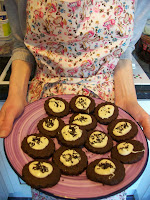
Obviously, I had to bake something immediately, although I have to confess that I put the apron on after I had finished to take the picture below- it is FAR too nice to spoil with flour and chocolate. This week I have been baking from the M and S "Easy Baking" book - an absolute steal at £3.50 in which I have already marked 8 recipes to have a go at. Here (with the apron!) are the chocolate sprinkle cookies - melt in the mouth chocolate biscuit with white chocolate icing and chocolate vermicelli.

..and here are the chocolate coconut crunch squares - a spongey coconut mixture on top of chocolate digestive base.
I also have my eye on baking the ginger topped shortbread, the banana and cranberry loaf, the marble cake, the white chocolate chip brownies and the sticky ginger cookies. Watch this space!

Monday, 17 May 2010

The Hopkins Manuscript (Sherriff)


It was with great sadness that I finished reading the last of the 88 Persephone books on my way home from London at the weekend. The Hopkins Manuscript by RC Sherriff was the last one that I came to. I am not quite sure why it ended up at the bottom of the pile, particularly as I had so much enjoyed Sherriff's Fortnight in September when I read it last year. I think perhaps it was because its sci-fi/dystopian themes are ones which I would normally shy away from in literature. But because it was a Persephone book I read it, and I am very glad that I had the opportunity to do so.

The manuscript referred to in the title was written by Edgar Hopkins, a 53 year old ex-school master, and was composed in order to record a series of terrifying events that faced the earth. Hopkins is content with his life in the small village of Beadle, rearing poultry for competitions and occasionally going up to town to meetings of the Royal Lunar Society. As a result of his membership of the group, he is among the first to discover that the moon is gradually moving closer to the earth and is estimated to collide with it in 7 months time. Initially this discovery is kept a secret, in order to protect the population, but it is then announced and the country has to come to terms with its imminent decimation and the likely end of the world. There is an admirable sense of "blitz spirit" with which preparations are made, and one of the things that made the book so readable for me was that Sherrif describes ordinary life and details and how the average person is affected by the impending disaster.

Like The expendable man, I don't want to reveal any more about the plot (although the majority of the reviews that I've seen on librarything and Amazon do); I'll leave it up to you to read the text. But if you want a tense, dramatic and extremely compelling read, then even if science fiction isn't your poison of choice, then I would strongly recommend this novel. It's not one that I have ever seen reviewed on a blog or ever heard anyone talk about, which is a shame

Persephone republished the novel in part as a comment on global warming, which they believe to be one of the greatest catastrophes facing the world today, and it is interesting to read the book in this context and to consider how society today might react to the catastrophe that Hopkins and his contemporaries faced.

And what will I do now that I've read all of the Persephones? Well, I've still got 9 more to collect, and there are some that I would like very much to re-read, especially following reading people's reviews during the Persephone Reading Week, particularly, Greenery Street, The new house, Family roundabout and all of Dorothy Whipple. The Persephone bookshop also have a wonderful table of "50 books we wish we had published"; as the Persephone imprint is a great endorsement of a good read, I may have to have a read of some of those (although I noticed that I had read quite a number already)